Ignite Summer Research Institute 2027
A selective two-week research program in Ann Arbor, Michigan. One cohort, one shared research curriculum, and a specialization you choose. You build an original research proposal and present it at a closing symposium.
Monday, June 28 to Saturday, July 10, 2027. Join as a Residential Researcher, a Day Researcher, or an Online Researcher.
In a Nutshell
The short version. Details follow below.
Three Ways to Take Part
You apply once. All three formats follow the same curriculum, are taught by the same instructors, and finish at the same symposium.
| Residential Researcher |
Day Researcher |
Online Researcher |
|
|---|---|---|---|
| Tuition | $6,990 | $3,490 | $1,990 |
| Daily hours | Resident for all 13 days | Morning through evening study | Academic core, live online |
| Housing | Included, supervised | Not included | Not applicable |
| Meals | All meals | Lunch and dinner | Not applicable |
| Academic core breakouts, research sessions, labs, guest speakers |
Full | Full | Full, live |
| Evening study and lab office hours | Included | Included | Included, second window for Asia-Pacific |
| Weekend excursions | Included | Included | Not applicable |
| Research symposium | In person | In person | Live by video |
| Certificate of Completion | Yes | Yes | Yes |
| Reference letter, based on a standardized rubric | Yes | Yes | Yes |
Flexibility if you cannot travel
Any admitted student who cannot travel may move to an Online Researcher place and receive a refund of the difference in tuition.
We also publish a date by which we confirm the residential cohort. If we do not reach the enrollment we need, you hear from us then, with an Online Researcher place and a refund of the difference or a full refund, rather than finding out weeks before you were due to travel.
What You Actually Do
Two weeks of structured research work, ending with something you can show. A proposal is the minimum. Some students get further.
A research curriculum
Seven sessions, taken by the whole cohort together, covering how research really works: forming a question, reading papers, choosing a method, academic integrity and responsible use of AI, and positioning your work against the literature.
A specialization
Daily breakout sessions in your chosen field, taught at university level by the professor who works in that area, with hands-on laboratory work every afternoon.
An original proposal, at least
You leave with a refined research question, an annotated bibliography, a methodology plan, and a research pitch you have delivered to an audience. That is the floor. Students who move quickly get into the work itself: collecting or selecting data, running a first analysis, testing whether an approach holds. How far you get is up to you and your mentor.
A symposium
On the final Friday you present your proposal formally, to peers, instructors and families. Online Researchers present live by video in the same session.
Guest speakers
Working researchers talk about what they do and how they got there.
A cohort
A small, selective group of students who take this as seriously as you do, which is usually the part people remember.
The Seven Research Sessions
These run across both weeks and are the same whichever track you take.
One Program, Seven Specializations
You are admitted to one program, not to one of seven. The program has two strands that run side by side.
Shared research curriculum
Taken by the whole cohort together. Seven sessions on how research is actually done: turning curiosity into a question that can be answered, reading a paper, choosing a method, academic integrity and the responsible use of AI, and positioning new work against what already exists.
Your specialization
Where that method gets applied to a particular field. Specializations meet daily as small breakout groups, led by the professor who works in that area, with laboratory work every afternoon.
The Seven Specializations
Biophysics, Imaging & AI
Seeing the machinery of living cells
Advanced microscopy, quantitative imaging, and machine learning applied to living systems. You explore how researchers extract quantitative information from biological images, formulate testable questions about cellular processes, and use computational methods to reveal structures and dynamics that conventional imaging cannot directly resolve.
Cybersecurity & AI
Protecting the systems everything else runs on
Machine learning applied to the security of connected systems, from the power grid to the devices in an ordinary house. How attacks are detected, how privacy survives data collection, and why the hardest problems here are as much about design as about code.
Corporate Finance
Data, decisions, and AI
Explore how managers and boards make decisions, how executive compensation shapes behavior, and how mergers and acquisitions create or destroy value. You use data and AI-assisted tools to investigate these questions, as corporate finance researchers do.
Health & Bioinformatics
Machine learning on living data
Pattern recognition applied to biological and clinical data, including genomic sequence analysis, biomarker discovery, and drug safety. Where machine learning meets questions that matter to patients.
Mathematical Foundations
The mathematics underneath machine learning
The structures that make modern AI work, approached the way mathematicians approach them. For students who want to know why the algorithms behave as they do, not only how to call them.
Statistics & Research Writing
From question to evidence
Ask a meaningful question, analyze real data, write a paper you can defend. You build and clean a dataset, choose an analysis that actually suits the question, and write a full paper with abstract, methods, results and discussion. Correlation against causation, confidence intervals, and why a result that is not statistically significant is still a result.
Research Storytelling
Evidence, narrative and academic writing
How writers make difficult evidence understandable without changing what it supports. You build a research dossier, trace striking claims back to their original sources, and write a narrative that is both engaging and verifiable. Includes a verification workshop where every name, date, quotation and number gets checked and logged. The one specialization that needs no quantitative background.
Choosing yours
You rank your preferences when you apply and we match you before you arrive. Specializations offered in a given summer depend on student enrollment and eligibility.
Who Teaches
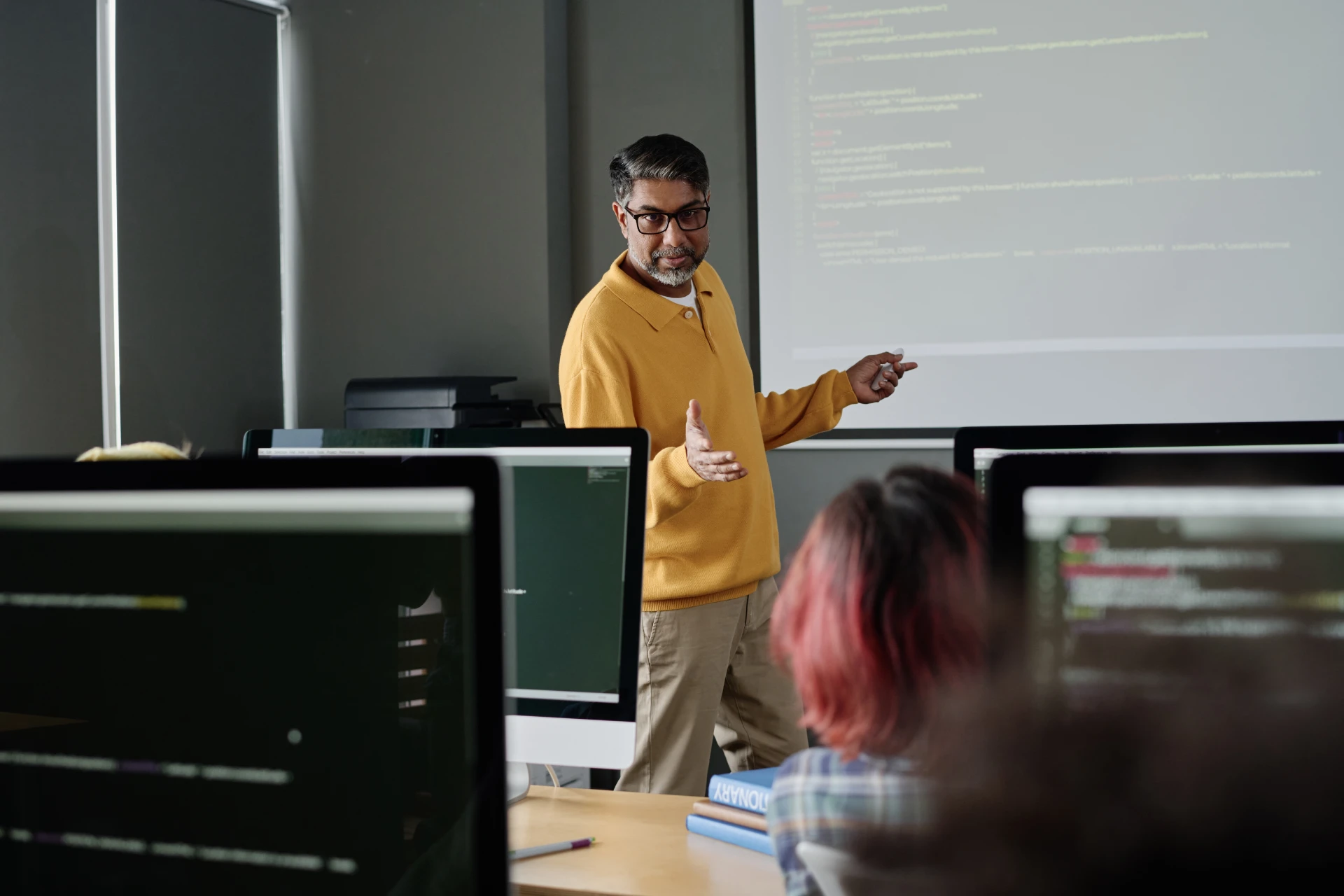
Six research-active professors lead the specializations. Small breakout groups, and the person running yours is the person doing the research.
This is not a first attempt
The faculty behind this program have been mentoring high school researchers since 2021, across ten cohorts and more than 120 students.
Those students have gone on to MIT, Stanford, Harvard, Princeton, Berkeley, Cornell, Carnegie Mellon, Penn, Brown, Chicago, Duke, Northwestern, Georgetown, Georgia Tech, UCLA, Wellesley, Harvey Mudd and Olin, and to Cambridge, Imperial College London and UCL abroad.
Between them, our faculty direct a National Science Foundation funded undergraduate research site, lead a National Science Foundation EAGER award to build hands-on machine learning labs for cybersecurity, hold a state Professor of the Year award, publish in leading journals in finance and in computing, have been recognized by the U.S. Food and Drug Administration for data-mining work, and have written award-winning books that explain mathematics to general readers. Four of the six hold faculty appointments at University of Michigan campuses.
Several run research programs for undergraduates during the rest of the year. The Institute applies the same approach to students who are still in high school.
Ignite Achievers is an independent organization. The Institute is not affiliated with, sponsored by, or endorsed by any university.
A Typical Week
Week one shown. The pattern repeats in week two, ending with the symposium.
| Time | Mon 28 | Tue 29 | Wed 30 | Thu 1 | Fri 2 | Sat 3 | Sun 4 |
|---|---|---|---|---|---|---|---|
| 09:00 – 10:00 | Welcome and introduction | Specialization | Specialization | Specialization | Specialization | Henry Ford Museum and Greenfield Village | Independence Day. Detroit River Walk, Eastern Market, fireworks |
| 10:30 – 11:30 | Research session 1 | Specialization | Research session 3 | Specialization | Research session 4 | ||
| 11:30 – 13:00 | Lunch | ||||||
| 13:00 – 14:30 | Research session 2 | Lab session | Lab session | Lab session | Progress check | ||
| 15:00 – 15:45 | Guest speaker | ||||||
| 16:00 – 18:00 | Social activity | ||||||
| 18:00 – 19:00 | Dinner | ||||||
| 19:00 – 21:00 | Study time and lab office hours | Free | |||||
Beyond the Classroom
Ann Arbor in summer, and the program is built to make use of it.
Dates and Deadlines
Applications are open for more than three months before the priority deadline, so there is time to prepare a considered application.
Who Should Apply
Grades 9 through 12
Students in grades 9 through 11 are the strongest fit. A finished research proposal in hand well before college applications open gives the work time to develop, rather than compressing it against deadlines. Seniors are eligible and welcome.
No prior research experience needed
Admission is selective, with no single cutoff. We look for evidence of academic strength and curiosity, such as strong academic performance, advanced coursework including AP or IB science and mathematics, participation or awards in mathematics, science or similar competitions, independent projects or research-related activities, and programming experience. These are factors we consider, not requirements. Students who have simply never had access to research opportunities are encouraged to apply.
Recognition
Something to take home from every student, and more for those who engage fully.
Every student who completes the Institute receives a Certificate of Completion. It names the student, the specialization, and the dates of the program, and it is signed by the program director and the faculty mentor. It marks what every student takes home: a research proposal, presented and defended at the closing symposium.
Beyond the certificate, students may also receive a reference letter for their college applications. The professor who supervised you writes it, based on a standardized rubric that reflects your engagement, effort, and growth as a researcher over the two weeks.
A letter from this program comes from a research-active professor who has watched you work on an open problem: how you handled an approach that did not work, how you defended your method, and how you responded when the data said something unexpected. That is a different document from a letter about classroom performance, and admissions readers can tell the difference. We hope the opportunity encourages every student to take full part in the program.
The Two Weeks Are a Beginning
Most summer programs end when the students go home. This one is built to continue.
A proposal is where most students finish the two weeks, and some finish further along than that, with data gathered and a first analysis run. Either way it is a starting point rather than a conclusion, and the students who get the most from this program are the ones who keep going. You can continue with your mentor through our online research programs, where the work becomes a full project and, for some, a paper submitted to peer review. The strongest proposals are considered for support through the Ignite Excellence Scholarship.
In practice many students stay with their mentor well beyond the formal end of a program, some for years. That continuity is the point. Two weeks can teach you how research works. Turning that into something publishable takes longer, and the relationship is what makes it possible.
Continuing the Work
Students whose proposals show real promise may be invited to continue the work after the summer, under faculty mentorship. Publication is not guaranteed. What we emphasize is authentic research, ethical scholarship, and genuine exposure to academic peer review.
Our 2025 cohort of 20 scholarship recipients produced six peer-reviewed publications with seven student co-authors, including papers in IEEE and ACM proceedings, with nine further papers under review.
Questions
What if I cannot travel?
You can move to an Online Researcher place and we refund the difference in tuition. You keep your place and your specialization.
Is the Online format a lesser version?
No. Online Researchers take the same curriculum, taught live by the same instructors, and present at the same symposium. What they miss is the housing, the meals, the excursions and the corridor conversations, which is why it costs less.
What is a Day Researcher?
A Day Researcher does the whole program and goes home to sleep: the research lab, the afternoon laboratory sessions, dinner, evening study, the social activities and the weekend excursions. The only thing a Day Researcher does not get is the bed and the breakfast. Some programs call this a commuter or day place.
Can I get a scholarship?
Partial merit-based and need-based awards are available. Full awards are not offered for the Institute, because a residential program has a fixed cost base. Our full awards go to the Ignite Excellence Scholarship, which supports our online programs.
Will I be published?
Not from two weeks, and anyone promising otherwise is overselling. You leave with a research proposal. If it shows promise you may be invited to develop it further under mentorship, and some of that work does reach peer review.
Share It
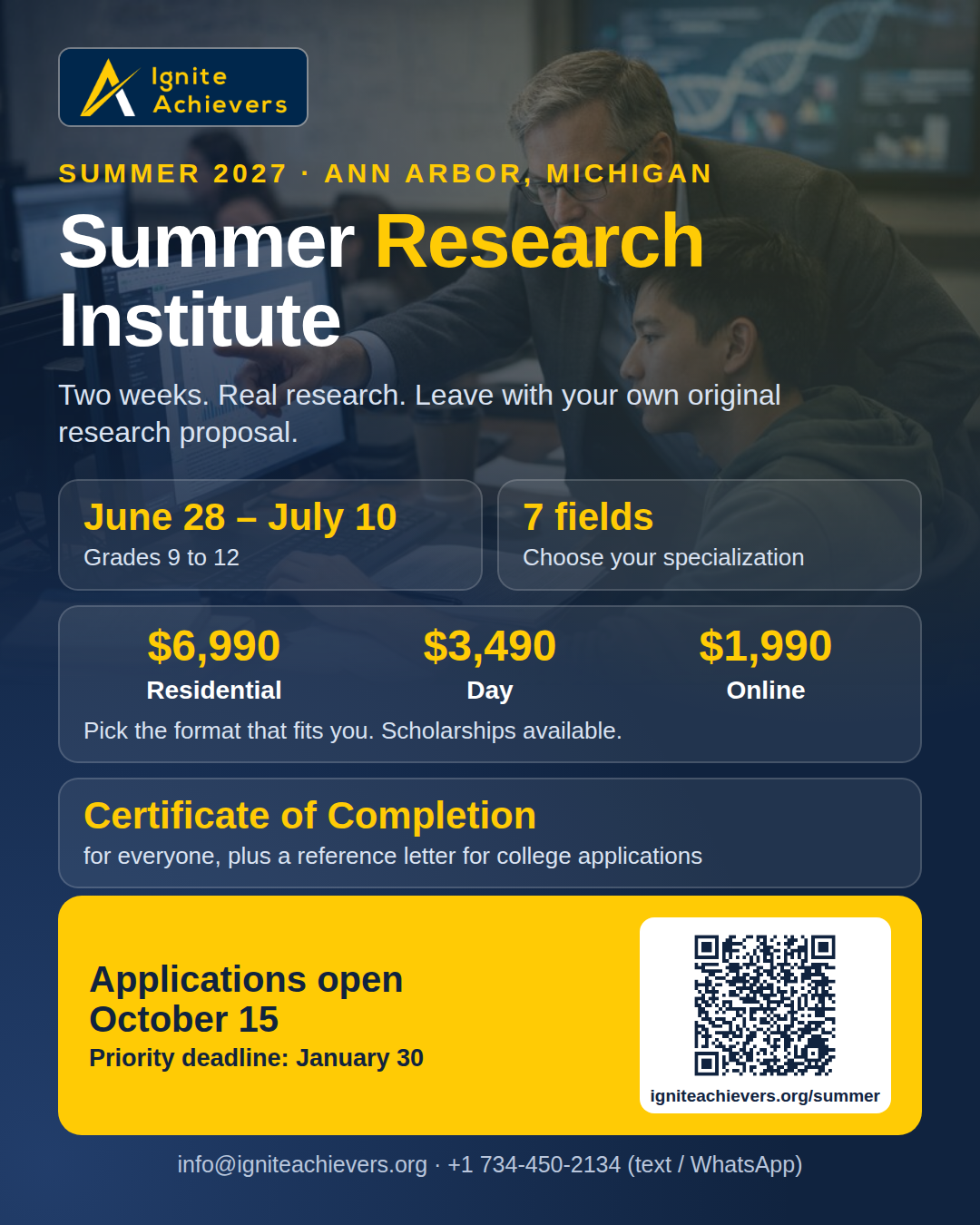
Know a student who would love this? Send them the flyer.
Register Your Interest
Applications open on October 15, 2026. Write to us and we will keep you posted on dates and information sessions.
In the meantime: info@igniteachievers.org